MU Shorts
Four players who could fill-in Carvajal’s spot at Real Madrid

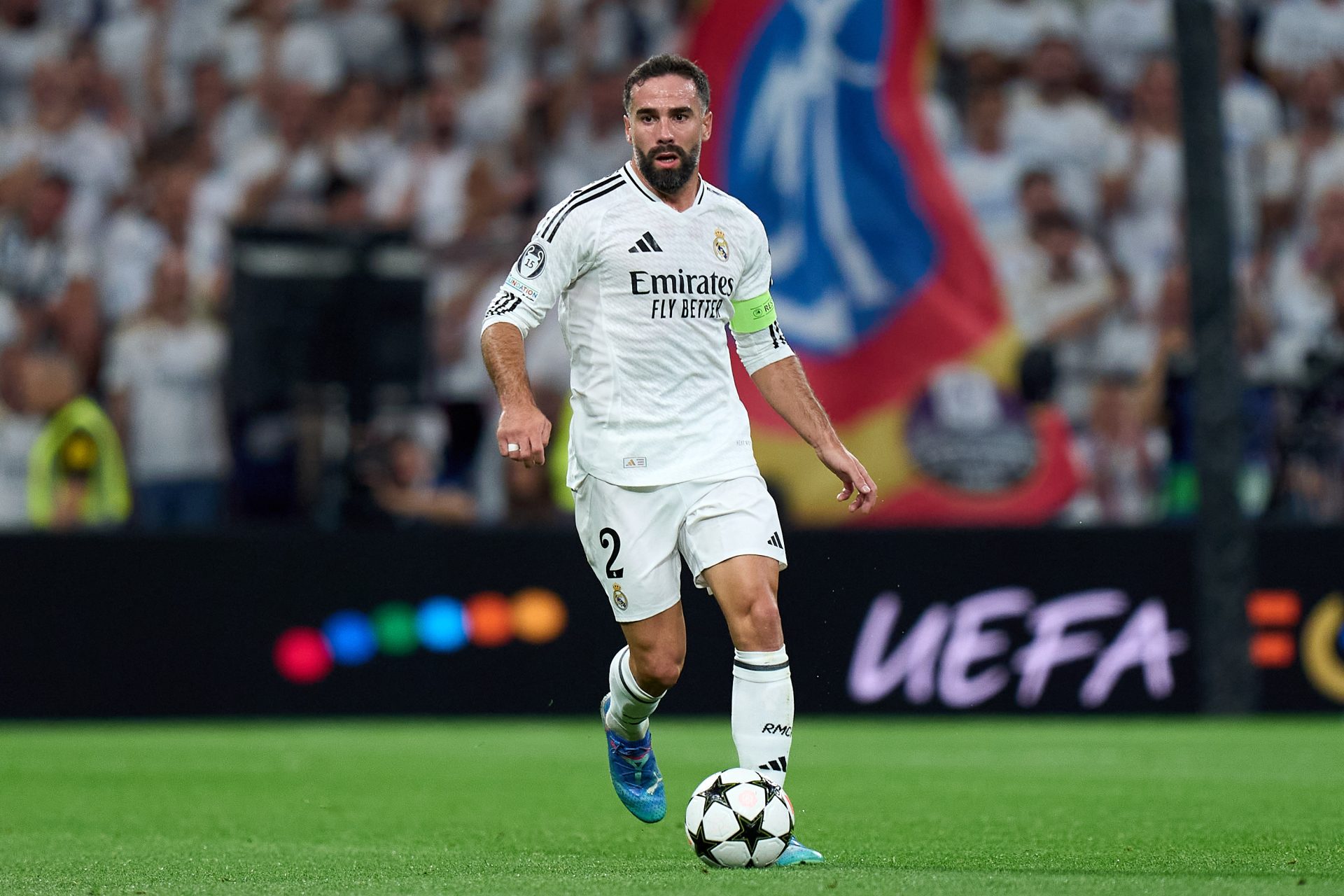
Real Madrid were dealt a significant blow with the news that Dani Carvajal will miss the entire season due to a serious knee injury.
As one of the club’s most dependable players over the years, his absence creates a serious gap at right-back and the club must look at alternative solutions to fill this crucial position.
Manager Carlo Ancelotti has several options at his disposal, but each comes with its own strengths and weaknesses. Let’s take a closer look at four players who could potentially take over Carvajal’s duties.
Raul Asencio – A tactical experiment

Raul Asencio is an intriguing option for the right-back role. While primarily known as a solid player on the ball, his passing ability—both short and long—could bring a unique dynamic to the position.
Ancelotti has already experimented with Asencio as a right-back during training sessions, which shows he sees potential in this adaptation.
Deploying Asencio in this role would require a tactical shift, particularly with Antonio Rudiger and Aurelien Tchouameni functioning as centre-backs. Asencio’s composure and technical skills could complement their defensive solidity.
However, this option remains largely untested in competitive matches, leaving question marks about how he would handle high-pressure situations against world-class wingers.
Lucas Vazquez – The natural replacement

Lucas Vazquez has often been Real Madrid’s go-to backup for Carvajal. His attacking instincts and familiarity with the role make him a logical choice.
However, his defensive frailties have been exposed in recent seasons, particularly when up against tricky and pacey wingers like Raphinha or Rafael Leao.
While Vazquez offers a safe pair of hands for most fixtures, his struggles against top-tier opposition may force Ancelotti to consider more defensively solid options.
Despite this, his understanding of Madrid’s system and chemistry with the squad makes him a reliable short-term choice.
Federico Valverde – Versatility at a cost

Federico Valverde has been a vital contributor on the defensive side for Real Madrid over the past two seasons, often covering for Carvajal during games.
His incredible pace and ability to break lines make him a strong candidate for the right-back position and he was solid against Leganes too.
The Uruguayan’s versatility is one of his biggest strengths, and his energy on the flank could offer both defensive stability and attacking thrust.
However, there is a significant downside to this solution. Moving Valverde to full-back would leave a massive void in Real Madrid’s midfield, where his contributions have been instrumental.
His ability to control transitions, press opponents, and link play would be sorely missed. Ancelotti would need to weigh the pros and cons of sacrificing his midfield dynamo for a temporary fix in defence.
Ferland Mendy – The unexpected solution

Another interesting option could be Ferland Mendy. With Fran Garcia fit and ready to occupy the left-back position, Mendy could be deployed as a right-back.
Although playing on his weaker side might pose challenges, Mendy’s defensive capabilities and experience as a full-back could make him a viable option.
This approach would allow Real Madrid to maintain balance in their backline while utilising both Garcia and Mendy effectively.
However, Mendy’s limited attacking output might restrict Madrid’s offensive play down the right flank, which has often been a key area for the team’s build-up play.



Real Madrid returned to winning ways with a narrow 1-0 victory over Villarreal, but the performance once again left a lot to be desired.
The result did little to hide the problems that continue to affect Jose Mourinho’s team, and the refereeing controversies became a talking point once more.
Yan Diomande’s second-half goal helped Los Blancos secure three valuable points. That said, Madrid struggled to establish sustained attacking control over the game.
There were some encouraging individual performances, but the same questions about the midfield, Arda Guler’s positioning and the team’s attacking structure cropped up.
Here are four things we learned from Real Madrid’s narrow 1-0 victory over Villarreal.
Yan Diomande is ready to start more regularly
Diomande was easily Madrid’s most dangerous attacking player against Villarreal, and his decisive goal was a consequence of an impressive performance.
What makes the youngster particularly valuable is his willingness to attack defenders directly. Madrid have often looked hesitant in possession this season.
They have kept the ball and circulated it without necessarily focusing on one-v-one situations, which could be directly related to Vinicius Junior’s poor form.
Diomande offered something different in this regard. His directness forced full-backs into making decisions and opened up space for his team-mates.
With Vinicius now facing a potential suspension, Mourinho has an obvious opportunity to give Diomande greater responsibility.
Valverde-Tchouameni double pivot does not work

Federico Valverde and Aurelien Tchouameni are excellent footballers. That said, they do not seem to work well together for Madrid.
Both offer physicality, defensive awareness and the ability to cover large areas. Those qualities are important, particularly for a team that can be vulnerable when opponents counter-attack.
However, Madrid’s biggest problem against Villarreal was not a lack of defensive protection. It was their difficulty progressing the ball into dangerous areas.
Too often, both midfielders moved the ball sideways without offering a penetrating option that broke the Villarreal defence.
Valverde’s greatest strengths include his powerful running and ability to influence different phases of play.
He looked much better operating as a flank player than as a midfielder, and it is high time Mourinho started using Bernardo Silva more regularly.
Arda Guler is far more useful operating centrally
Guler’s positioning remains another important tactical question. The Turkey international possesses the vision, technical quality and passing range to influence the game and turn it in Madrid’s favour.
Against Villarreal, Madrid looked more fluid whenever Guler moved inside and helped connect the midfield with the forwards.
From central positions, he can receive between opposition lines, combine with Jude Bellingham and identify forward runs before defenders have time to react.
Even if Guler starts on the wing, his primary role has to be drifting inside and almost acting as a second No. 10 in build-up alongside Bellingham.
Having excellent attack-minded overlapping right-backs like Denzel Dumfries and Trent Alexander-Arnold allows Guler to do just that.
Madrid must start using Guler more centrally in the coming weeks and make use of his excellent vision to improve their attacking structure.
A group of talented individuals

Perhaps the biggest concern is that Madrid continue to look more dangerous through individual moments of brilliance rather than collective play.
There is no shortage of quality. Mbappe, Vinicius, Bellingham, Guler and Diomande all possess the ability to decide matches.
However, Mourinho is yet to identify a system that gives the team structure and allows these stars to thrive in unison.
When one player receives possession, team-mates should already be moving into positions that create multiple options.
Too often, Madrid’s attackers appear disconnected, leaving the player on the ball to solve the situation alone.
With a trip to the Spotify Camp Nou approaching, Madrid need to address this situation sooner rather than later.
Mourinho has the talent available. Now he needs to make those players function as a team if he harbours any hope of success in La Liga this season.